

The book that probably has had the biggest impact on my thinking is The Black Swan by Nassim Taleb (I’ve read it 3x). The main theme of the book is that important events that have the biggest impact on our lives, so-called “black swans,” are unpredictable—things like 9/11, the financial crisis, COVID-19, having your plane lose an engine, etc. (Here are five other books that have had outsized impact on my worldview)
In The Black Swan, Taleb cautions against relying on mathematics and statistics to predict unpredictable events because they cannot be mathematically modeled due to their inherent unpredictability. We tend to think of randomness in our lives as similar to probabilities in games like roulette, cards, or dice. Thinking this way is a reasoning error that Taleb refers to as the “Ludic Fallacy.” The real world is much messier than the world of games, and life cannot accurately fit into probability distributions. Let’s look at examples.
A Casino Doesn’t See Their Biggest Risks
You’d think that the people who run a casino would be among the world’s foremost risk authorities because they are experts at probability and chance. But Taleb tells a story of a casino that had trouble with its approach to risk management. They had implemented processes and procedures to identify any cheaters among the gamblers, manage potential losses from high-rollers on winning streaks, handle any mishandling of money by employees, and other similar risks. The problem was that these risks were the obvious ones that came from within its business. But it turns out that the casino’s biggest risks weren’t the expected ones. Instead, they were ones unrelated to gambling or fraud:
- “First, they lost around $100 million when an irreplaceable performer in their main show was maimed by a tiger (the show, Siegfried and Roy, had been a major Las Vegas attraction). The tiger had been reared by the performer and even slept in his bedroom; until then, nobody suspected that the powerful animal would turn against its master. In scenario analyses, the casino had even conceived of the animal jumping into the crowd, but nobody came near to the idea of insuring against what happened.”
- Next, “casinos must file a special form with the Internal Revenue Service documenting a gambler’s profit if it exceeds a given amount. The employee who was supposed to mail the forms hid them, instead, for completely unexplainable reasons, in boxes under his desk. This went on for years without anyone noticing that something was wrong. The employee’s refraining from sending the documents was truly impossible to predict. Tax violations (and negligence) being serious offenses, the casino faced the near loss of a gambling license or the onerous financial costs of a suspension. Clearly, they ended up paying a monstrous fine (an undisclosed amount), which was the luckiest way out of the problem.”
- Third, the casino’s daughter was kidnapped, which caused the casino owner to dip into the casino’s coffers (in violation of gambling laws) to secure the vast amount of cash for the ransom.
The point of these examples is that the real risks the casino faced were outside of their risk models. Taleb estimated that these losses were 1000x what they incurred from gambling-related risks.
Fat Tony & Dr. John
What should we do instead? We need to make sure that we’re not relying on gamified probabilities when making decisions — acknowledge that the unknown unknowns will happen and that you can predict them.
And be skeptical.
Another story from The Black Swan about “Fat Tony” and “Dr. John” illustrates this point. Fat Tony is street-smart; Dr. John is a former engineer and an actuary. They are presented with the following fact situation:
Taleb: “Assume that a coin is fair, i.e., has an equal probability of coming up heads or tails when flipped. I flip it ninety-nine times and get heads each time. What are the odds of my getting tails on my next throw?”
Dr. John: “Trivial question. One-half, of course, since you are assuming 50 percent odds for each and independence between draws.”
Fat Tony: “I’d say no more than 1 percent, of course.”
Taleb: “Why so? I gave you the initial assumption of a fair coin, meaning that it was 50 percent either way.”
Fat Tony: “You are either full of crap or a pure sucker to buy that ’50 percent’ business. The coin gotta be loaded. It can’t be a fair game. (Translation: It is far more likely that your assumptions about the fairness are wrong than the coin delivering ninety-nine heads in ninety-nine throws.)
Classic. The point is to think outside of the box!
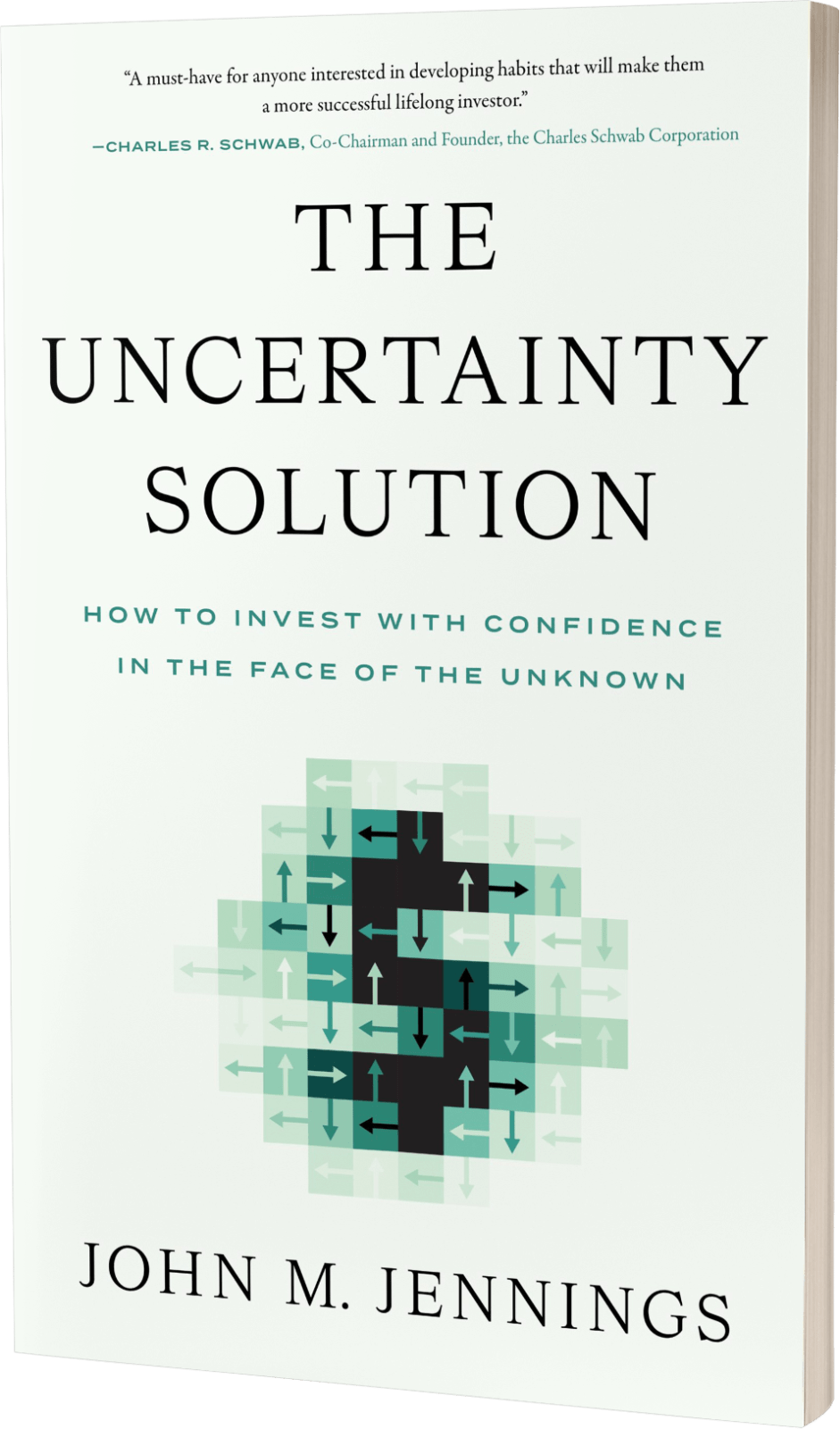
Do you like thinking about how to better deal with uncertainty and randomness? I wrote an entire book on that topic. It’s pretty good.

Yes. I’m on Goodreads. I don’t keep all my books up to date though. Here’s my profile: https://www.goodreads.com/user/show/74521071-john-jennings
I’d love to connect.
The Black Swan sounds like a great read. I’ll check it out!
John – are you on Goodreads as an author or reader? Would be happy to connect there, if so. Thanks for the always interesting articles to ponder.